

Protecting Homeworkers in the Garment and Footwear Sector: Lessons from Australia
By WIEGO
Read More
The garment industry exemplifies the challenges of global manufacturing: low wages, “flexible” (or no) contracts, and poor working conditions. Garment and textile workers in informal employment, a huge workforce in some countries, are often invisible – especially those who work in their homes. But garment workers are organizing and policy gains are being made.

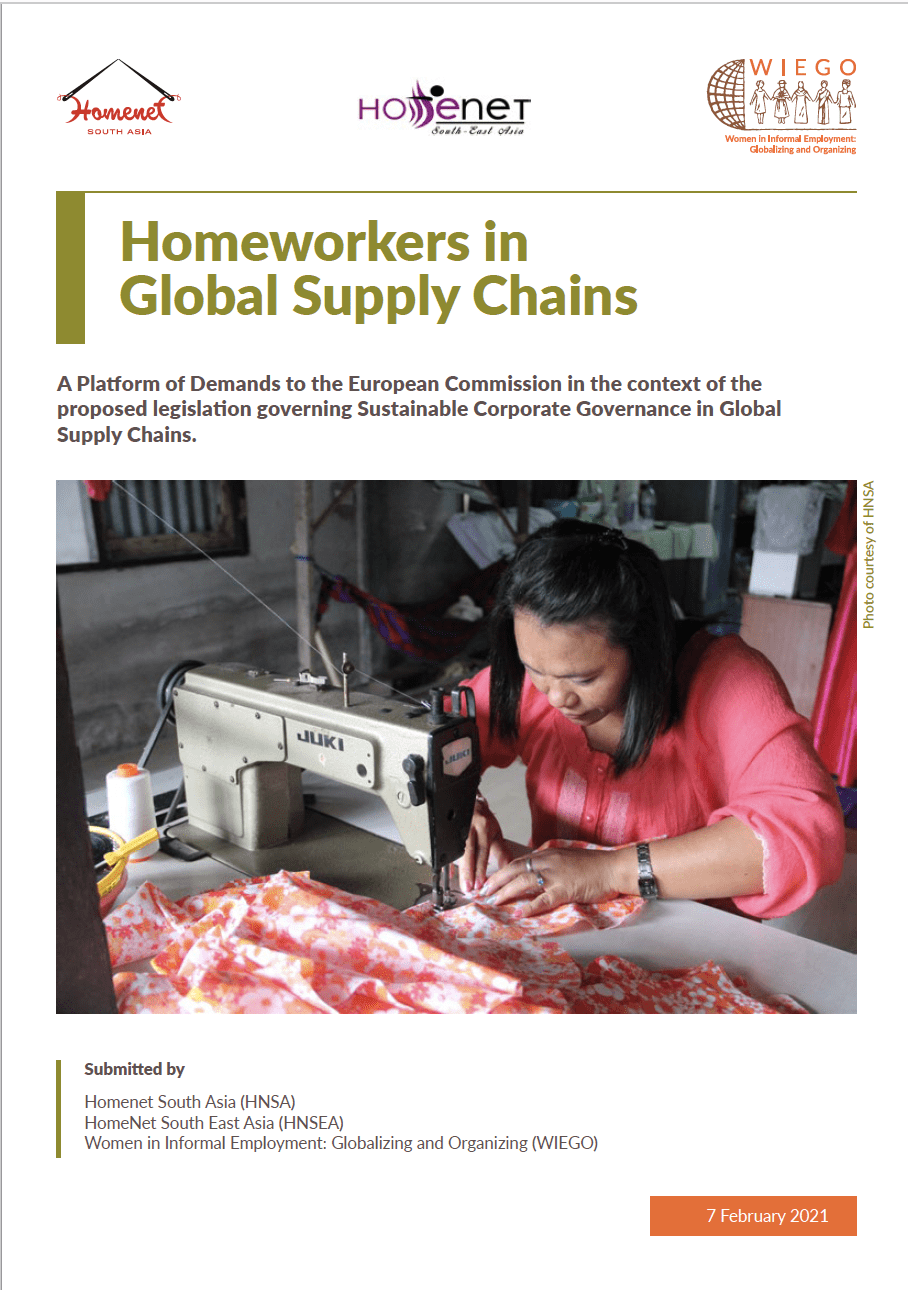
A woman from HomeNet South Asia (Sadhna) in India carefully embroiders a vibrant pink and orange fabric, showcasing traditional craftsmanship.
Workers in the garment and textile industry work in various parts of the manufacturing process, often outside of factories. Homeworkers and home-based workers form a significant portion of the garment worker sector.
Homeworkers are workers who receive raw materials, specifications and orders for the production of goods from an individual or a firm (often through an intermediary) to produce goods or provide services from their homes. They usually work in or around a home. The work contracted to homeworkers includes finishing work for factory-produced garments, such as stitching buttons, cutting and trimming threads, stringing, embroidering, removing foam, knotting, hemming, crocheting, folding, labelling and packing.
Home-based workers are self-employed garment workers who buy their own raw materials, supplies and equipment and sell their own finished goods.

In many countries, the garment industry is the largest employer in manufacturing. But because garment workers are often informally employed and home-based, they are unseen and thus rarely represented in national statistics (Chen, Sebstad, and O’Connell 1999).
Learn More(this link opens in new window)of non-agricultural subcontracted home-based employment in Thailand was related to garments and textiles, according to a survey by Thailand’s National Statistics Office.
homeworkers in India are in domestic and global supply chains of garment and textile industries.
A survey by Thailand’s National Statistics Office found that, among subcontracted workers, about half of non-agricultural home-based employment was related to garments and textiles (NSO 2007). Thailand’s Office of Homeworker Protection estimated there were over 950,000 homeworkers in 2005, with the majority women. HomeNet Thailand believes this number is now close to 2 million.
In Bangladesh, the garment industry is the principal export earner. In the late 1990s, Bangladesh’s garment industry had about 350,000 workers in formal and semi-formal employment, making it the fourth largest employing sector (Bajaj 1999: 19). Although there are no official estimates, the Bangladesh Home Workers Association believes there are millions of home-based garment workers in the country, as entire rural families are involved in traditional embroidery work (Bajaj 1999: 19).
In 2012, there were 37.4 million home-based workers in India. Of these, around 45% were involved in making garments or textiles, and, based on 1999 data, 45% of garment and textile workers were sub-contracted homeworkers. In 2021-2022, around 88% of India’s employed population were informal: 91% of employed women and 88% of employed men. In 2019, more than one-third of urban women workers were in four informal sectors and, among them, 22% were home-based workers. Similarly, about one-fourth of the rural women workers belonged to these sectors and, among them, 22% were home-based workers. Among home-based workers are millions of homeworkers who are part of the country’s domestic and global supply chains.
Home-based garment workers contribute to the household budget and, by working from home, to the care of children and older people, to the quality of family life, and to the social fabric of their communities.

BANGKOK, THAILAND: Kanyapat Buason sews garments at a unique workers'-owned factory on the outskirts of Bangkok. Their main income is from sub-contracted work for a Thai polo-shirt company whose owner is willing to pay higher-than-average rates for quality products, which, in turn, support the higher, decent wages of the workers. Photo Credit: Paula Bronstein/Getty Images Reportage
Garment workers who are homeworkers or home-based workers often prefer to work from their homes. They usually carry the double burden of paid work along with child care and household work. Also, social and cultural constraints sometimes prevent women from going out of their homes to work. The driving forces and working conditions for homeworkers and home-based workers differ. Subcontracted homeworkers face low wages, low or no legal protection, and fluctuating work loads. They bear additional production costs and are vulnerable to economic slowdowns. Home-based workers face these difficulties as well as infrastructural challenges with housing, transport and electricity.
Contracting in the garment sector relies on “flexible” production, which results in uncertain and often rushed work. Manufacturers underbid each other for orders from large retailers who demand low-cost production and just-in-time delivery. These retailers, aided by bar-code technology, have adopted “lean retailing” to keep their stocks as low as possible (McCormick and Schmitz 2001).
The location of work, the volume of orders, and length and terms of employment contracts are all flexible, to suit those at the top of the supply chain. Garment workers tend to be hired during peak seasons and laid off when demand slackens.
Homeworkers in the garment supply chain are often excluded from national labour laws. Sometimes countries classify them as self-employed and not as employees. This leads to their exclusion from employment and labour rights, affecting their rights to organize and to bargain collectively, as well as their rights to minimum wages. This also affects regulation of their hours of work, social security, occupational health and safety, and other working conditions.
Some countries include homeworkers in their national labour laws or have specific legislation for homeworkers, but even in these countries, the laws that would give homeworkers rights similar to those of formal workers are not enforced.
Most homeworkers in the garment and textile industry are paid by the piece (according to how many items they produce), earn very little, and do not receive overtime pay. Most receive no sick leave or paid leave.
Subcontracted homeworkers have little power over the terms and conditions of their work. In Bangkok, 60% of subcontracted workers in WIEGO’s IEMS study reported that wages were set by the contractor; 51% said they could not bargain.
By hiring homeworkers to do the labour-intensive work of assembling garments and paying them by the piece, subcontractors keep their wage costs and overheads low, and minimize the risk of loss associated with uncertain orders (Carr, Chen and Tate 2000).
In addition to low piece rates, homeworkers – who have to cover costs of production such as workplace, equipment and utilities – sometimes must wait months to be paid.
A study conducted by the Worker Rights Consortium between 2001 and 2011 across 15 countries found garment workers’ wages declined overall.
Home-based garment workers in the IEMS were directly affected by larger economic trends. In Ahmedabad, for example, the global recession had a significant and lingering impact on the garment sector. Also, there is evidence to suggest that the use of contract labour in garment manufacture increased after the global financial crisis in India and possibly in Bangladesh (Chan 2013).
Economic crises exacerbate poverty and risk for garment workers. HomeNet Thailand found that during the economic crisis in the late 1990s, the garment industry in many Asian countries declined, piece-rate wages and job orders dropped dramatically, and payments were delayed while costs rose (HomeNet 2002).
For home-based garment workers in the IEMS study, small and inadequate housing was a major problem. A small house hampers productivity because a worker cannot take bulk work orders as she cannot store raw materials. Also, work is interrupted by the competing needs of other household activities.
Poor quality housing is another problem. Equipment, raw materials and finished goods are damaged when roofs leak or houses flood.
Electricity shortages and load-shedding severely affect the livelihoods of home-based garment workers. In Pakistan, a majority of IEMS respondents in Lahore reported that when shortages occur, they cannot work. Reduced production reduces the ability to meet daily food requirements, so they must work harder and longer hours when electricity is available to complete orders. If they cannot get orders completed, the intermediary gives the work to others instead. Many workers have shifted to physically demanding manual machines, so that they can work in daylight to complete their work.
Transport problems emerged as significant for homeworkers in the IEMS study. Since the women must travel to obtain raw materials, increased public transport costs and travel distances impact the viability of their enterprises.
Home Based Workers Map(this link opens in new window)
Home-based garment workers rarely have appropriate protective equipment and may be unaware of safety measures. Health risks in the garment industry include repetitive strain injuries, dust from cloth pieces and, in the case of some dyes, exposure to poisonous chemicals (Laungaramsri 2005). Family members can be equally at risk of exposure due to shared living and working space.
Garment workers around the world, especially those who do the basic stitching of children’s and women’s garments, are predominantly women. But often, some of the higher-skilled tasks, such as cutting, are done by men. And where products require more technical skills to produce, women have been squeezed out of garment manufacturing by men, who have more opportunity to learn the required skills (Carr, Chen and Tate 2000).
Export factories tend to hire young, single women and let them go if they marry or become pregnant. This is one reason why banning homework in global supply chains would be devastating for women who rely on the income.
In developed countries, many garment workers – in factories and working from their homes – are immigrant women from Asia or Latin America. In Los Angeles, USA, most garment factory workers are from Latin America and Asia. In Toronto, Canada, most garment workers are Chinese immigrant women who worked in small factories before the North American Free Trade Agreement (NAFTA), but now work from their homes.
In developing countries, notably in China, many garment factory workers are migrant women from rural areas.

A close-up of a worker's hands in Tiruppur, India, crafting blue ribbon decorations during COVID-19.
Effective policies and programmes are crucial for improving the rights and conditions of garment workers. These measures can provide legal recognition, social protection and fair labour standards.
The International Home Work Convention (C177) was adopted by the International Labour Conference in 1996. C177 calls for national policies to promote equality of treatment between homeworkers and other wage earners. It also specifies areas where such equality of treatment should be promoted, including inclusion in labour force statistics.
Around the globe, home-based worker organizations have advocated for their national governments to ratify and implement C177. But almost 30 years later, only 13 countries have ratified it. The European Commission adopted a recommendation calling on all European Union governments to ratify the convention in 1998 (McCormick & Schmitz 2001).
In 2016, members of the WIEGO Network participated in the general discussion on decent work in global supply chains at the International Labour Conference. The official Conclusions recognized homeworkers as legitimate workers in global supply chains.
Many brands have adopted homeworker policies and the OECD Due Diligence Guidance for Responsible Supply Chains in the Garment and Footwear Sector has a module on home work. Forty-eight countries are signatories to the OECD instruments.
WIEGO produced a guide, How Homeworkers Can Use the OECD Due Diligence Guidance for Responsible Supply Chains in the Garment and Footwear Sector, which explains the key provisions for multi-national enterprises, their responsibilities to workers in their supply chains – including homeworkers –and how homeworkers’ organizations can use the OECD Guidance and complaints process in their advocacy strategies.
In December 2020, the EU Council adopted Conclusions on Human Rights and Decent Work in Global Supply Chains and requested the EU Commission to draft a legal framework that would make it mandatory for all companies established or retailing in the EU to undertake human rights and environmental due diligence in their supply chains. Informal Workers, Social Audits, Human Rights and Due Diligence in Supply Chains explains why this is important. In 2021, homeworkers’ organizations and WIEGO created the Global Supply Chains: Platform of Demands to the European Commission. We have worked with other organizations and the trade union movement to identify key messages and deepen the capacity of homeworkers’ organizations to engage in advocacy.
Since the start of the COVID-19 pandemic, homeworkers who are subcontracted by global supply chains have either not received new orders or their regular orders have not been renewed.
In April 2020, WIEGO joined a demand for global brands in the fashion industry to extend a one-time Supply-chain Relief Contribution to all garment workers during the COVID-19 crisis. Workers include time-rated, piece-rated, subcontracted and other homeworkers. There was a bottom-up process for the determination of the one-time Supply Chain Relief.
Rising global demand for cheap, labour-intensive goods spurred regional competition and put pressure on Thailand’s manufacturers to cut costs. Casual employment and subcontracting to homeworkers was a strategy to circumvent labour laws and lower costs (Doane 2007).
HomeNet Thailand, with support from WIEGO and other partners, campaigned for more than a decade to win legislative protection for homeworkers. Both the Homeworkers Protection Act B.E.2553 and a social protection policy came into force in 2011. The law mandates fair wages – including equal pay for men and women doing the same job – be paid to workers who complete work at home for an industrial enterprise.
The Kathmandu Declaration addresses the rights of South Asian home-based workers. It was adopted in 2000 by representatives of South Asian Governments, UN agencies, NGOs and trade unions from five countries at a regional conference organized by the Self-Employed Women’s Association (SEWA), UNIFEM and WIEGO and supported by the Aga Khan Foundation Canada.
WIEGO commissioned the research findings on which the Kathmandu Declaration was based.
Garment workers, especially home-based workers who engage in ready-made garment production, have little if any bargaining power. They may deal only through an intermediary and have no contact with the main contractor. The intermediary may also have little power.
Most garment workers are not organized. In export processing zones, garment factories typically do not allow unionization. This is not new. In the 1990s, evidence suggests union leaders were among the first to be let go in East Asia’s garment industry when the financial crisis hit (Delahanty 1999).
Garment makers are organizing to increase their bargaining power and, with it, their security in this globalized trade. Worldwide, there are examples of how organizing is improving the situation for these workers and the number of organizations, as well as national and regional networks of such organizations (called HomeNets), is growing.
In India, SEWA has worked to organize garment workers, concentrating on higher piece rates and fairer working conditions. In 1986, SEWA negotiated a minimum wage for garment stitching. They have helped garment workers demand better wages, working conditions, identity cards and social protection, such as child care and health benefits (Chen 2006).

Ahmedabad, India: Rehat Rangrez (left), Noorjahan Makrani (centre), and Sangeeta Parmar (right) create handcrafted bags at the Self Employed Women's Association (SEWA) Artisan House—SEWA is a trade union for poor, self-employed women in the informal sector. The House was opened in 2014 to support women artisans in the informal sector to continue their craft and increase their earning power. The Artisan House also sells their products, eliminating the issue of a middleman cutting into the women's small incomes. Photo Credit: Paula Bronstein/Getty Images Reportage