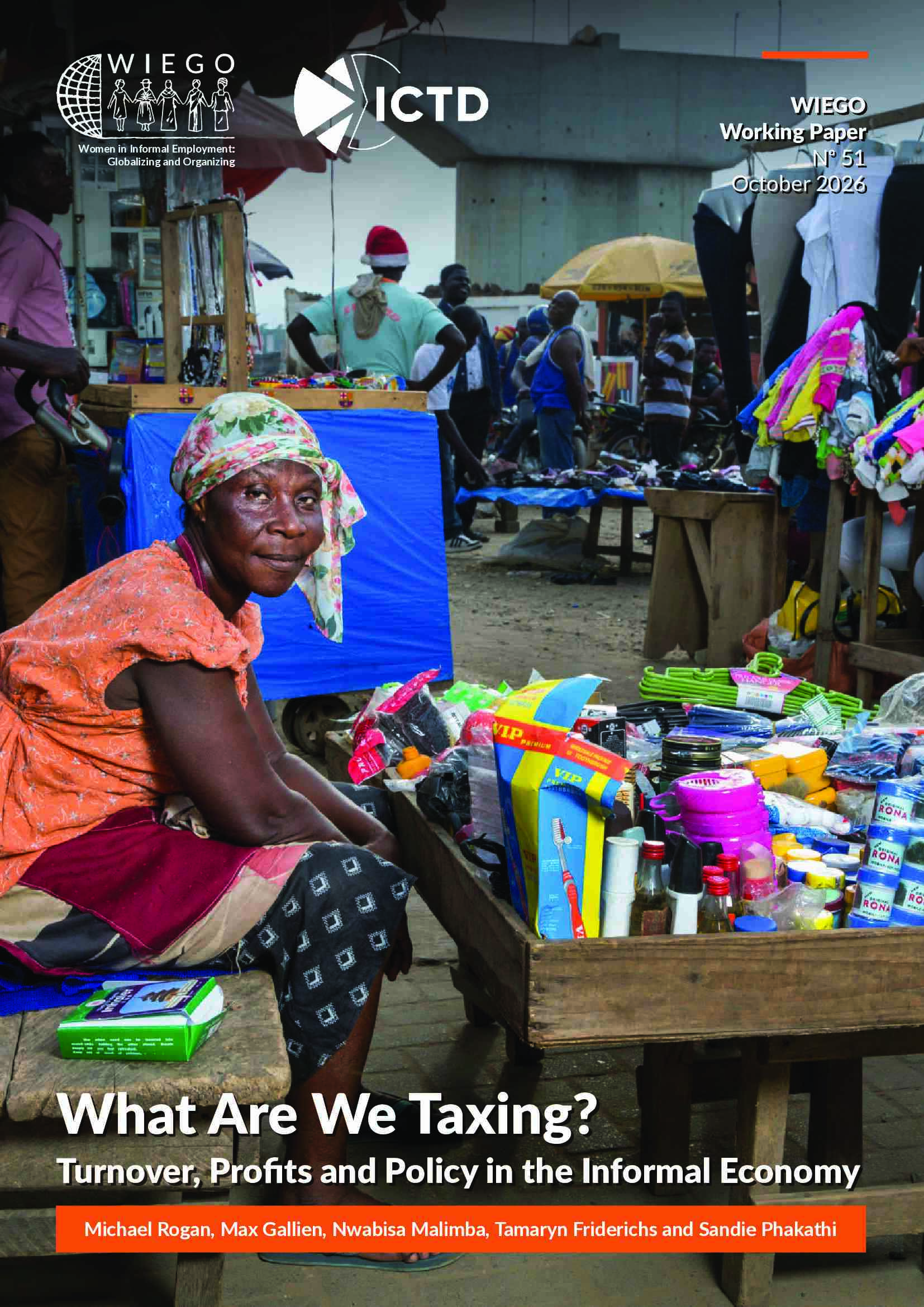
What Are We Taxing? Turnover, Profits and Policy in the Informal Economy
Turnover‑based presumptive tax regimes are increasingly popular among lower‑income countries as they attempt to collect more taxes from large informal sectors. In theory, these tax regimes can be progressive and potentially efficient tax handles. In practice, their results have been extremely disappointing on both revenue and equity grounds. Why? And how can they be designed better? At the heart of this question lies the relationship between profit and turnover in informal sector enterprises. Due to limited bookkeeping, estimations of turnover are central to the design and implementation of presumptive tax regimes. And yet, there is almost no literature or data exploring the relationship between profit and turnover among informal firms, and its implications for tax design.
WIEGO’s Working Paper No. 51 seeks to fill that gap using a harmonized dataset from the World Bank’s Informal Sector Enterprise Surveys across a sample of 10 low‑income countries. Our results suggest that turnover is a highly unreliable proxy for profit and, consequently, tax liability. Profit as a share of turnover varies considerably by country and by sector, and does not increase proportionately or predictably with turnover. We conclude with a simple illustration of how a turnover‑based simplified tax regime can result in both horizontal and vertical inequalities in tax liability, using Ghana’s modified tax scheme as an example. The findings suggest that where turnover is used as a proxy for taxation, its imprecision needs to be built into policy design to avoid taxing firms at varying rates of their profits and shifting excessive burdens onto very low‑income operators. These findings are applicable to other policy interventions that rely on turnover in their design, such as regulatory exemptions, formalization strategies or social protection schemes.
View list of all: Working Papers