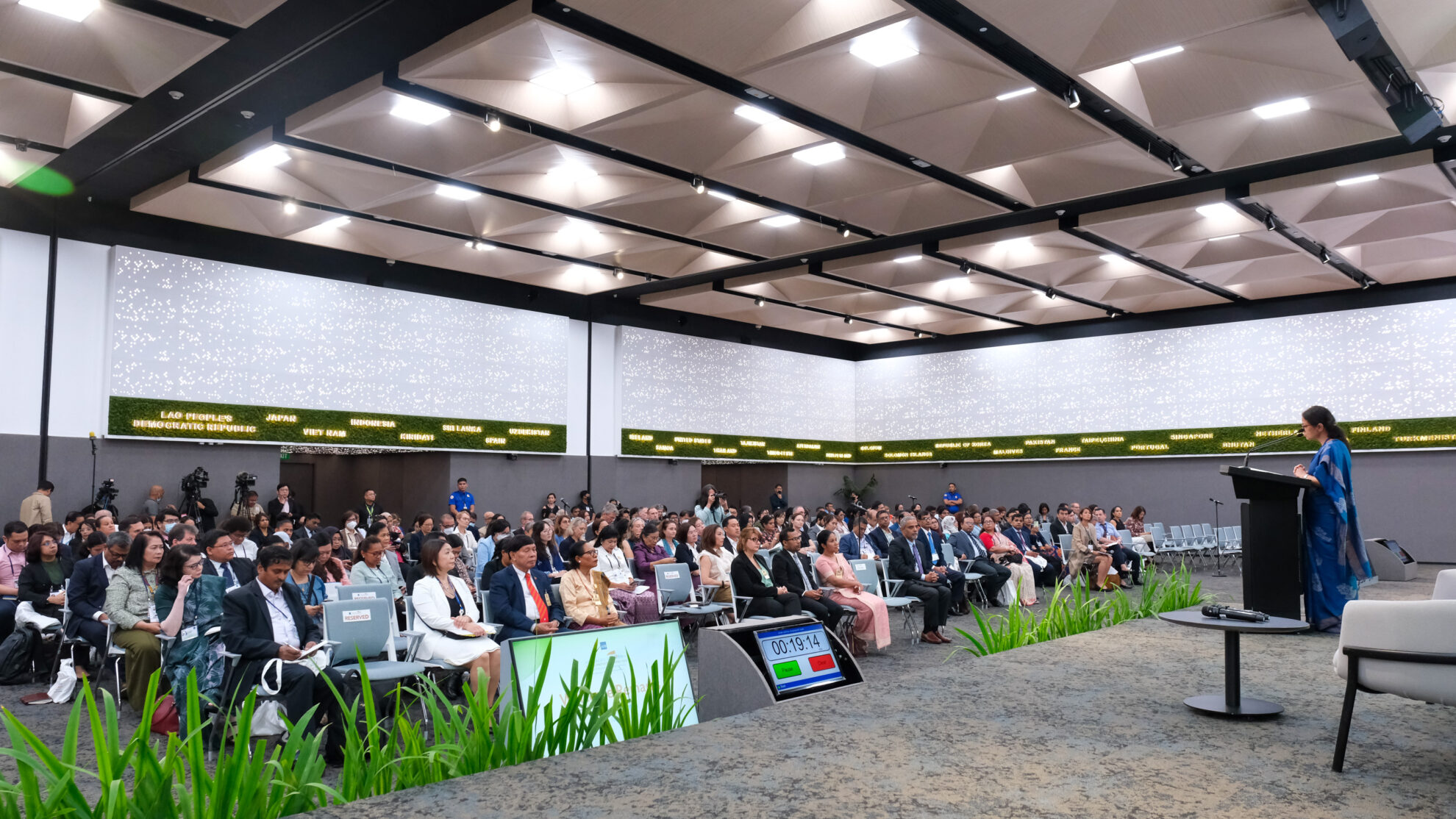
WIEGO is presenting at the Asia Pacific Social Protection Week alongside representatives from the World Bank, ILO and participating governments, to discuss the future of social protection in the region.
Climate change, population ageing, the gender gap, technological advances and changing labour markets are intensifying the challenge of building social protection systems that are inclusive, resilient and financially sustainable across Asia and the Pacific – a region where informal employment represents 65% of total employment, with only 34% of the working-age population legally covered by comprehensive social security.
Across two panels, WIEGO speakers will examine how social insurance can reach workers who have historically been excluded, and how sustainable financing, effective partnerships and political support can help secure social protection systems for the future.
WIEGO’s Social Protection Programme Director, Renata Nowak-Garmer, will speak in a plenary session about securing the future of social protection. Aura Sevilla, WIEGO’s Advisor for Southeast Asia and Older Workers, will join a panel about rethinking social insurance.
Is it Working for Our Workforce? Rethinking Social Insurance
On 7 October, WIEGO’s Aura Sevilla will join a panel considering how social insurance can reach the ‘missing middle’ – workers in informal employment, self-employed workers, micro-enterprise workers and workers with fragmented employment histories – while remaining financially sustainable in ageing societies.
Social insurance – sometimes referred to as work-related social protection – has a crucial role to play in inclusive, resilient and sustainable social protection systems. Workers, employers and governments often share responsibility for paying social contributions, enabling workers to access health insurance, parental benefits and pensions in order to manage life-cycle risks.
Insurers, pension funds and other financial institutions can also play complementary roles by helping to mobilize long-term savings and support retirement security.
Meeting the challenge
Asia and the Pacific is experiencing the most rapid population ageing in the world, making it increasingly important to extend old-age protection to workers with limited or interrupted contribution histories.
This challenge is particularly acute for women, who are less likely to have formal employment-based coverage and more likely to be penalized for taking time away from full-time work to undertake unpaid parental or caregiving responsibilities.
Panelists will consider innovative efforts to rethink social insurance systems and extend coverage to previously unprotected workers, including:
- Legal and policy reforms
- Administrative and operational adjustments
- Digital innovations
- Contribution subsidies
- New partnership models involving employers, insurers, pension administrators, financial institutions and technology providers
The discussion will include the People’s Republic of China’s initiative to extend coverage to workers in the digital and platform economy, beginning with an employment injury insurance pilot, and Nepal’s effort to bring informal and self-employed workers into the national social insurance system.
Securing the Future of Social Protection
WIEGO’s Renata Nowak-Garmer will speak at this high-level plenary session on 8 October to consider how social protection systems can be made fit for the future: how they can be sustainably financed, how effective partnerships can support them, and how the political and public support needed to sustain them across electoral cycles can be secured.
The sustainability of social protection financing is emerging as one of the defining policy and governance challenges across Asia and the Pacific, particularly amid climate change, population ageing and rapid technological advancement.
Representatives from the International Labour Organization, the World Bank, and government representatives from Bhutan and Bangladesh will debate:
- Effective long-term financing: How can social protection systems secure the funding needed to empower and build the resilience of future generations?
- Diverse partnerships: How can stronger partnerships between national and local governments, civil society and the private sector bring capital, innovation and operational expertise while ensuring commercial incentives align with social objectives?
- Sustained political commitment: How can governments establish stable and predictable policy, regulatory and supervisory frameworks that allow private investors, financial institutions and employers to participate over the long term?
The discussion will consider how market-based solutions can complement, rather than replace, public provision to expand coverage, improve efficiency and strengthen long-term sustainability.
Panelists will also explore how strong monitoring and learning systems can demonstrate the value for money offered by social protection systems and build confidence among citizens, policymakers and investors.
About Asia-Pacific Social Protection Week 2026
Under the theme Empowered Lives, Resilient Futures, Asia-Pacific Social Protection Week 2026 brings together government leaders, policymakers, practitioners, development partners and innovators to share practical solutions and help shape inclusive, resilient and sustainable social protection systems.
Building on events held in 2016, 2019 and 2023, APSP 2026 will focus on empowering people, strengthening resilience and ensuring social protection systems remain sustainable as the region navigates current vulnerabilities and future challenges.

