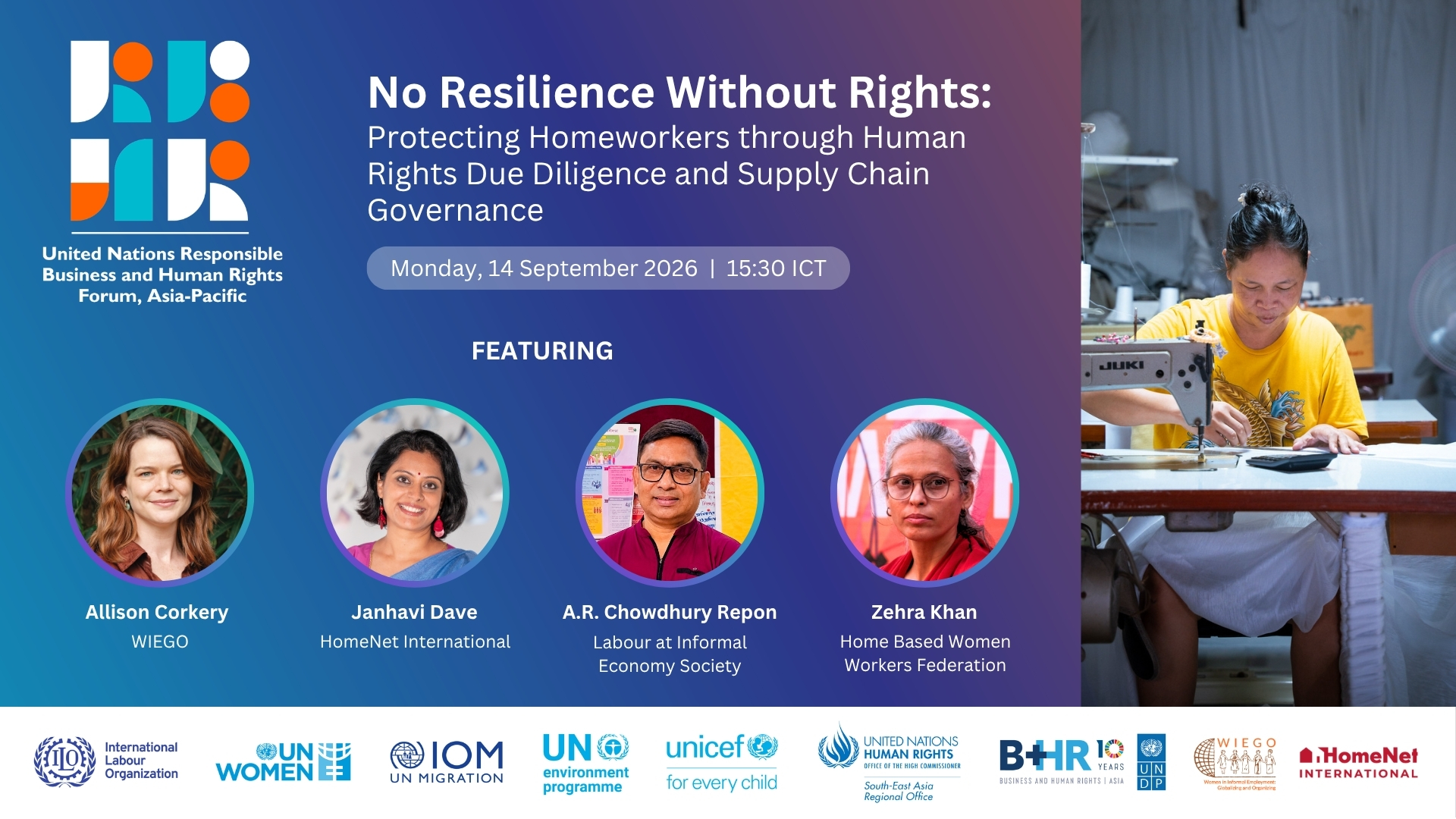
WIEGO and HomeNet International are hosting a deep-dive session at the United Nations Responsible Business and Human Rights Forum, exploring how human rights due diligence can reach all workers in the supply chain, including homeworkers.
Homeworkers are an essential part of global garment, textile and footwear supply chains. However, they are among the least visible workers in the global economy, often hidden behind layers of suppliers, intermediaries and subcontractors and excluded from labour rights protections, supply chain governance and corporate accountability mechanisms.
The session explores emerging approaches to regulation, worker voice, and shared responsibility, bringing together diverse perspectives on how they reinforce one another to reshape supply chain governance.
Drawing on worker-led experience from Pakistan, Bangladesh and Thailand, the panel will discuss how systems thinking can strengthen supply chain governance to build more inclusive, accountable and resilient supply chains.
It will bring together worker organizations, policymakers, brands, manufacturers and civil society to identify practical approaches to extending human rights due diligence (HRDD) to homeworkers and other workers beyond Tier One.
Tier One factories are those that deal most closely with the manufacturing company, often having a direct contractual and business relationship.
This session is part of a multi-year initiative between HomeNet International and WIEGO.
Speakers:
- Janhavi Dave, HomeNet International
- Allison Corkery, Women in Informal Employment: Globalizing and Organizing (WIEGO)
- Zehra Khan, Home Based Women Workers Federation
- A.R Chowdhury Repon, Labour at Informal Economy Society
About HomeNet International
HomeNet International (HNI) represents more than 1.5 million home-based workers from 71 organizations across 30 countries. The network aims to raise the visibility and recognition of home-based workers as workers, build solidarity among home-based workers around common issues, and use the power of a global voice to influence governments and employers. Through organizing, advocacy and international solidarity, HNI advances decent work, labour rights and social protection for home-based workers worldwide.
About UNRBHR
The UNRBHR brings together governments, business, civil society and rights holders together to turn commitments into real-world outcomes.
Its theme this year is Building Resilience, Advancing Rights. In a time of overlapping economic, climate and geopolitical shocks, the forum asks how the region can build resilience while advancing human rights.
The forum focuses on practical exchange, peer learning and collaborative problem solving, and is organised around four thematic tracks: governance and regulatory coherence; resilient markets and supply chains; remedy, accountability and trust; and inclusion, participation and protection.

