
Occupational Health & Safety in the Informal Economy
WIEGO undertook a research project focused on occupational health and safety (OHS) for informal workers from 2009-14. Coordinated through WIEGO’s Social Protection Programme, the OHS project operated in Brazil, Ghana, India, Peru and Tanzania. A project was added in South Africa.
Our groundbreaking OHS project explored how OHS could be developed and delivered to meet the needs of informal workers.
OHS does not usually cover informal workers. It has traditionally focused on formal workplaces, not on where the majority of workers really work: on the streets, in their own homes, on garbage dumps and at landfills, for example. Often, these workers experience very poor and hazardous living and working conditions. The OHS project considered new forms of support from governments, and from those who profit from the work of informal workers but do not contribute to improving their place of work.
Overall project objectives
- understand better the risks faced by poorer workers in the main places where they work
- identify how to modify legal and institutional barriers to the inclusion of informal workers and workplaces into OHS
- support and assist MBOs of informal workers in shaping focused demands for OHS interventions and in negotiating for policy change and implementation
- understand the allocation, control and flow of resources to OHS in order to identify spaces for reallocation or increased allocation to informal workers and workplaces
- help build in-country research and organizing capacity in OHS for informal workers
- improve the collection and reporting of country-based statistics on OHS for informal workers to international regulating agencies (such as ILO and WHO)
- contribute to the development and implementation of an expanded or alternative curriculum which integrates OHS for informal workers and workplaces into mainstream OHS training institutions
We continue to work with in-country researchers and with informal worker organizations and to investigate better ways to deliver healthcare to informal workers.
Understanding Health Service Provision from the Perspective of Informal Workers
What is it like to be an informal worker in need of health services? What barriers to informal workers face in accessing these services? What would help to bring down these barriers? Read first hand accounts from India, Thailand and South Africa in the stories of Ushaben, Xolisile, Koon, Kanchana and Subhadraben.
WIEGO’s Occupational Health & Safety (OHS) for Informal Workers Project worked in six countries:
The OHS Project concluded in 2014, although WIEGO, through our Social Protection Programme, continues to work in this arena as part of the Workers’ Health pillar.
 Learn more and subscribe to stay informed
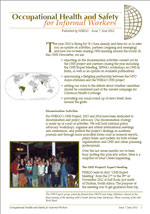
OHS Newsletter: Read our collection of OHS newsletters produced between 2010 and 2014. We have now integrated our work on informal workers’ health into the WIEGO newsletter.
Subscribe to receive WIEGO’s e-news